The Team Behind the $1.3B Grocery-Linked Finance Platform Is Building the Open Network for U.S. Grocers
Company
We are building the open financial value network for grocers and the households they serve.
In the face of rising food costs, household providers go through a weekly money-management routine: what money is available, what needs to be bought, and how far the grocery budget can stretch. Money management happens before and after each grocery purchase, as households plan what they can spend, reconcile what they spent, and adjust the rest of the week. With American households making 2.8 grocery trips per week, grocery creates nearly 300 money-management touchpoints each year, making it one of the most frequent financial routines in the household rather than just a purchase category.
That frequency creates attention, intent, and data around one of the household’s most important spending decisions. But the value around that decision is fragmented. The bank owns the account. The card network owns the payment economics. Loyalty, offers, receipts, media, e-commerce, and customer data sit in separate systems. As a result, shoppers receive less value, grocers lose control of the financial relationship, and merchants lack proof of what worked.
Members of our team built and scaled the grocery-linked financial products behind PC Financial, part of one of Canada’s most successful closed-loop retail ecosystems — in which was acquired by EQ Bank for $1.3B. Across the teams experience at Walmart, Instacart, PC Financial, Toast, Shipt and other commerce infrastructure environments, we have seen what happens when these systems are connected. They become a value engine.
But our experience also showed us what the market often misses. Consumers do not live inside one closed loop. They move across grocers, banks, merchants, apps, wallets, cards, and everyday services. Every time they move, value becomes harder to measure, fund, attribute, and return.
Our thesis is the inverse of the closed-loop systems we helped build. Those ecosystems proved the value engine works, but kept it inside the walls of one enterprise. Cashberry is breaking that model open for grocery, creating a network where value can be generated, verified, attributed, and returned wherever the shopper spends. Grocery is the wedge because money management already happens there multiple times every week.
Over time, we believe that our strategic positioning of an open financial value network places Cashberry on a path to become the primary way people bank.
Why It’s a Problem
The problem is not that value is missing. The value already exists across payments, rewards, offers, loyalty, media, merchant budgets, and household spend. The problem is that there is no unifying layer that connects it.
The bank owns the account. The card network owns the payment economics. The loyalty platform owns the offer logic. The ad platform owns the measurement. The merchant funds demand. The grocer owns one of the most trusted consumer relationships. But none of these systems work together in a way that consistently returns value to the shopper, the grocer, or the merchant.
That fragmentation creates a massive value leak. We estimate that more than $50B in annual value is trapped, wasted, or never returned because payments, rewards, offers, loyalty, media, and attribution do not interoperate. Across 200M U.S. grocery shoppers, that is the equivalent of $250 per shopper per year in value sitting outside the connected grocery relationship.
Most grocers cannot solve this alone. In the U.S. alone, there are more than 45,000 supermarkets, and most do not have the resources to build a bank, card program, rewards network, retail media business, merchant-funded offer platform, and attribution layer on their own.
What We Built
We are building the unifying layer that connects value across shoppers, grocers, and merchants, so everyday spend can be measured, funded, attributed, and returned.
Vault AI connects the commerce systems grocers already run: loyalty, payments, offers, receipts, retail media, e-commerce, and customer data. Work that once took months can move in days. Executives can see where value is moving, which customer segments are responding, which campaigns are working, and what to do next.
Branch is the managed financial program for grocers. It lets them co-brand and distribute consumer financial products inside the Cashberry mobile app, without building banking infrastructure themselves.
Treasury is the campaign and rewards layer. It helps merchants and vendors fund offers, manage rewards, measure performance, and prove outcomes.
Together, Vault AI, Branch, and Treasury give grocers the infrastructure to launch financial products, activate shoppers, manage funded value, and measure revenue impact.

Why Now
The value leak is compounding.
Consumer spend is rising, grocery costs are increasing, and household savings are shrinking. As more dollars move through fragmented payment, loyalty, offer, media, and attribution systems, more value is lost before it can reach the shopper, the grocer, or the merchant. Our model shows trapped consumer value growing from $50B today to approximately $72.5B by 2029 if the systems remain disconnected.
The timing is right because market pressure and enabling infrastructure have arrived at the same time. Consumers need more savings on essential spend, grocers need new revenue beyond the basket, merchants need clearer proof of performance, and retail media needs stronger purchase attribution. At the same time, financial technology has made banking-powered products easier to launch, while AI can now connect fragmented commerce systems faster than legacy integration cycles allowed.
The cost of fragmentation is now too large to ignore, and the infrastructure to solve it is finally ready. Cashberry connects the systems that move value around grocery and turns them into one open financial value network.
Why We’re Raising
We are opening this round to move from partner validation to live market execution.
The capital gives Cashberry the balance sheet foundation required by our sponsor bank, while supporting account activation, early payment volume, and the operating proof needed to scale with larger grocers. It also advances the enterprise deployment requirements for Branch, Treasury, and Vault AI.
This round turns signed grocery demand into a repeatable enterprise model.
What This Unlocks
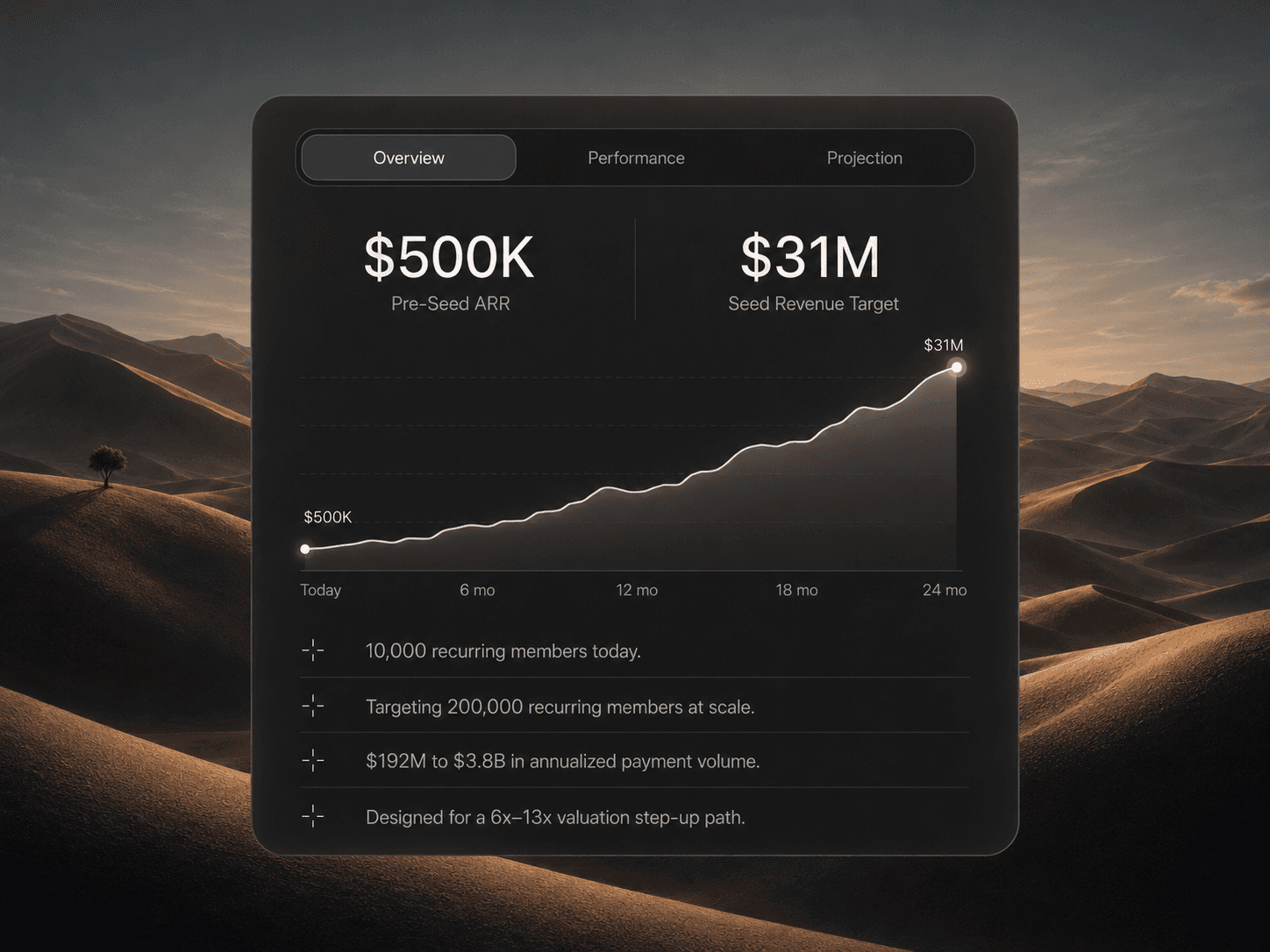
Within 12 months of the next financing round, our target is to scale toward 200,000 recurring members, $3.8B in annualized payment volume, and $31M in annualized retained revenue. At a 3x revenue multiple, that supports a $93M valuation and a 6x step-up from this round.
The Invitation
We are looking for investors who understand that grocery is becoming a financial, loyalty, and commerce network. Grocery is more than a retail category. It is a distribution channel, a financial relationship, a data layer, and one of the most important consumer touch points in everyday life.
Relevans posts


Reach the right grocery opportunities.
Join the Nourishe Provider Network to access qualified demand aligned with your solutions, capabilities and the outcomes you deliver.
Welcome back
How can I help you today, Alex?
Ask anything about your business.
Overview
Program
Activation
Campaigns
How many shoppers converted within the last 7 days?
What is the average basket size?